Authentication providers
This document applies to version 4.0 P23 and above.
Simplicité offers a wide array of authentication solutions with the following ones working out-of-the-box, with no coding involved:
- internal: this is the default classic Simplicité mechanism that store user's passwords in the database
- OAuth2
- SAML
- LDAP
- Crowd (external Atlassian Crowd authentication)
There can be as many providers as necessary.
Configuration
The authentication providers are to be configured with the AUTH_PROVIDERS system parameter, e.g.
[
	{
		"type": "internal",
		"name": "simplicite",
		"visible": false
	},
	{
		"type": "oauth2",
		"name": "google",
		"label": "Sign in with Google OAuth2 IdP",
		"sync": true,
		"client_id": "<my client ID>",
		"client_secret": "<my client secret>"
	},
	{
		"type": "saml",
		"name": "google",
		"label": "Sign in with Google SAML IdP",
		"sync": true
	},
	{
		"type": "ldap",
		"name": "openldap",
		"visible": [ "http://localhost:8080"]
	}
]
Common settings
The JSON settings include the common attributes:
| Setting | Supported values | Required | Comment |
|---|---|---|---|
type | internal, oauth2, saml, ldap, crowd | Required | |
name | String | Required | provider name (must be unique per type) |
visible | true (default) / false / Array | optional | can be an array of base URLs for which the provider is visible |
label | String | optional | label on the provider choice page |
sync | true / false | optional | |
image | String | optional | disposition resource name |
For historical reasons the names google, microsoft, linkedin and franceconnect are reserved as they correspond to dedicated connectors.
If the provider is configured as not visible, it is still accessible by appending ?_provider=<type>:<name>
(e.g.: ?_provider=internal:simplicite) to the base URL.
Specific settings
Extra mandatory settings might exist depending on the provider's type, please refer to the corresponding authentication documentation for details.
Deprecated syntax
Before Simplicité v4, providers were configured in individual system parameters instead of one single JSON. PEM certificates are embeddable in the JSON as base64 starting of v5.3.39.
| Setting specification | Example | |
|---|---|---|
In AUTH_PROVIDERS as JSON | <setting (lowercase)> | "client_id" |
| Deprecated in v4 Individual system parameters | <type (uppercase)>_<setting (uppercase)> <provider (lowercase)> | OAUTH2_CLIENT_ID google |
| Deprecated in v5 Image as implicitly specified resource name | <type (uppercase)>_SIGNIN_<provider (uppercase)> | LDAP_SIGNIN_MYOPENLDAP |
Some of the provider settings are still documented with the deprecated syntax.
Troubleshooting
To investigate authentication issues, one useful tool is the DAUTHCS001 log event.
By default, it is configured as a Debug (D) event because the output is verbose and can leak secrets,
so it has to be activated when necessary by setting it to an Information (I) event.
Make sure to deactivate it as it produces very verbose output. Whatever method you chose, you'll have to set the level back to the Debug value (D)
UI activation
The value is only updatable by users with the ADMIN_SYSTEM user parameter set to yes.
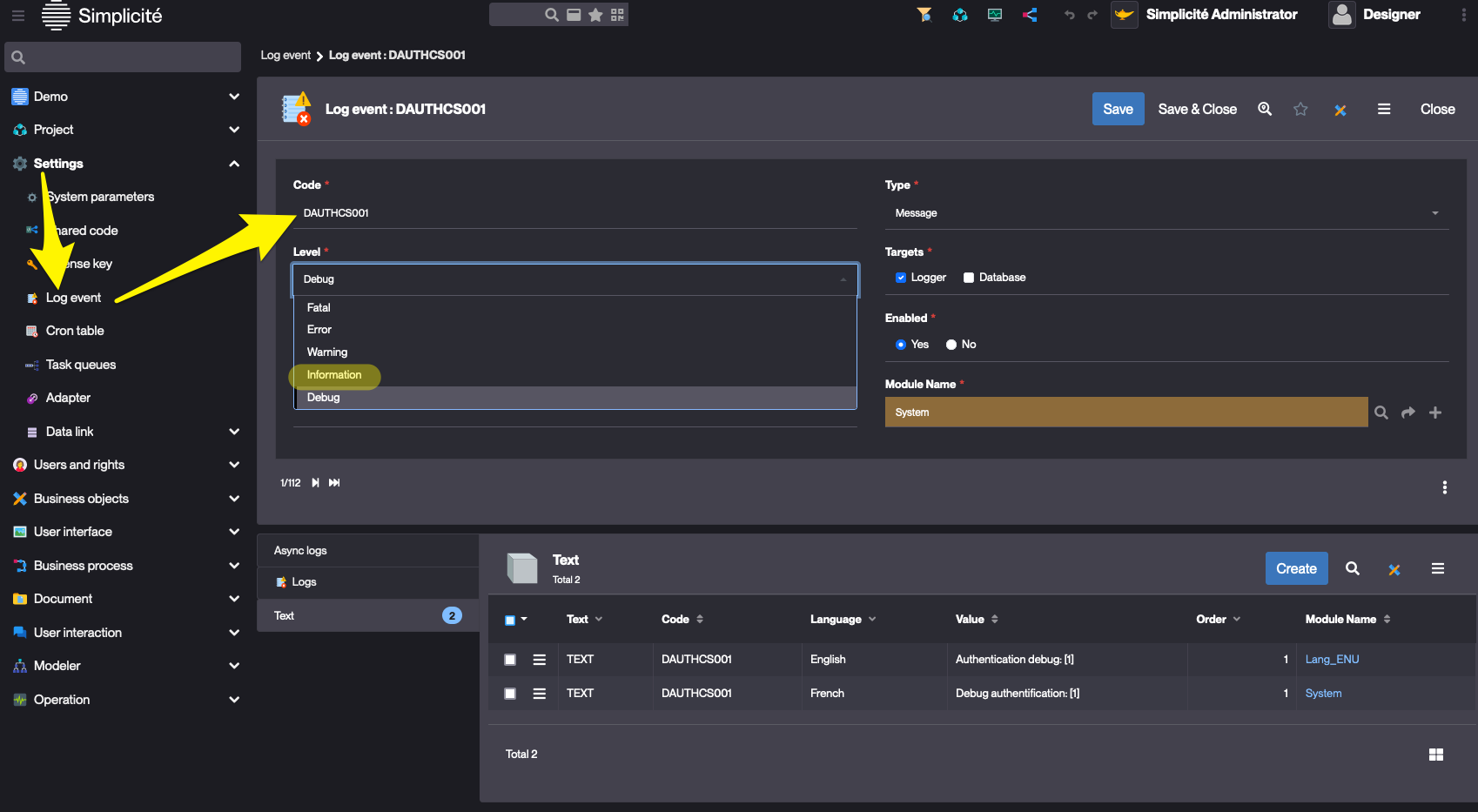
Before Simplicité v6, this menu item used to be in the "Operation" domain, in the extended view.
IO activation
When deali!ng with authentication problems, it is sometimes impossible to access the UI, and you might defer to the I/O services
curl -u designer:$IO_PASSWORD --form service=jsonimport --form "file=@-" $INSTANCE_URL/io <<'EOF'
[{"name":"LogEvent","action":"update","data":[{"lev_code":"DAUTHCS001","lev_level":"I"}]}]
EOF
curl -u designer:$IO_PASSWORD --form service=clearcache $INSTANCE_URL/io
Database activation
As a last resort, that's how the change can be made at database level
UPDATE m_log_event SET lev_level='I' WHERE lev_code='DAUTHCS001';