CI/CD
Objectives: demonstrate initialization of a Simplicité module and setup of a Continuous Integration pipeline, with:
- JUnit unit tests check
- Jacoco unit tests code coverage
- Sonar code quality check
This document focuses on an example based on a Gitlab + Portainer infrastructure, but is easily portable to other code versioning and orchestration tools (Github, Kubernetes, SIM, etc.).
Prerequisites
SonarQube Cloud does not support linking an organization to more than one DevOps platform at a time. If the user's mail is already part of a Sonarcloud organization linked to GitHub, then Github should be used instead of Gitlab. Alternatives include deploying a SonarQube instance, using another code analyzer, etc.
- a Portainer instance with access to Simplicité images
- git installed locally
- a gitlab.com account, configured for access from local repositories
- a sonarcloud account
1- Versionning
This section initializes the project, setting up a developpement instance and the gitlab repo
Gitlab
- create blank public project/repository
- copy repository URL
Simplicité
- deploy a developpement Simplicité instance from Portainer
myapp-dev.my.domain - create an empty module, and configure the settings field like specified below
- create an init commit (prefer json exploded export type)
- copy repository URL
{
	"type": "git",
	"origin": {
		"uri": "https://gitlab.com/simplicite-gitlab-group/module-myapp"
	},
  "export": {
    "format": "xml|json",
    "exploded": true|false
  }
}
Local repository
Clone the Simplicité repo and push it to gitlab:
git clone https://myapp-dev.atelier.simplicite.io/git/MyApp
cd MyApp
git remote add gitlab https://gitlab.com/simplicite-gitlab-group/module-myapp
git push -u gitlab master
2- Deploy test instance
For most of the steps of the CICD, a clean slate with Simplicité and the app's configuration is needed. The DevOps platform (Gitlab, Github, etc), thus needs to instruct an orchestrator to deploy just that. A set of CLI tools interacting with portainer allows to do various operations on the CLI. Let's install the tools, test them locally, then configure the devops platform to deploy a test instance at each commit.
Simplicité CI Tooling
Download the Simplicite CI tooling in the ./others directory of the server:
mkdir others
cd others
curl -o myapp-compose.yml https://raw.githubusercontent.com/simplicitesoftware/resources/refs/heads/master/public/portainer_templates/demo-tmp.yml
curl -O https://raw.githubusercontent.com/simplicitesoftware/simci/refs/heads/main/simci
chmod +x simci
Adapt the docker compose file (myapp-compose.yml) to the project's values. For a blank project, it should mainly be the importspec:
[...]
MODULES_IMPORT_SPEC: |
  title: "${COMPOSE_PROJECT_NAME}"
  modules:
    - name: "MyApp"
      git:
        uri: "https://gitlab.com/simplicite-gitlab-group/module-myapp"
[...]
Create a .env file with the correct values for local testing:
IO_PASSWORD="change-me_more-than-32-chars"
PORTAINER_SERVER="top-domain"
PORTAINER_API_TOKEN="get-the-token-in-portainer"
STACK_NAME="test-simci"
Create and run an executable test-simci.sh file
#!/bin/bash

set -a
source .env
set +a

./simci portainer-stack-deploy -f myapp-compose.yml $STACK_NAME $PORTAINER_SERVER
You should get some information in return, and after a while, a "healthy container" message in the CLI.
Connect to the app and check that the module was correctly pre-installed:
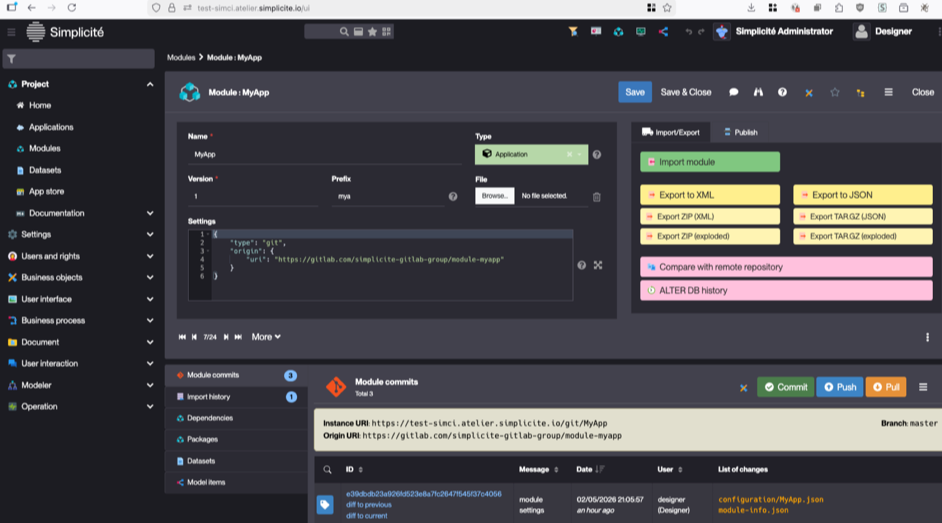
If any of the following apply, investigate before going any further:
- the instance is not accessible at the expected URL
- the module is not pre-installed, with the init commit effectively present
- HTTPS is not functional
Now that the tooling is properly installed and functional, let's commit the changes:
git commit etc etc
Gitlab pipeline
Create .gitlab-ci.yml with a simple "build" stage and a single "deploy-test job":
stages:
  - build

deploy-test:
  stage: build
  script:
    - export PORTAINER_API_TOKEN="${PORTAINER_API_TOKEN}"
    - export IO_PASSWORD="${IO_PASSWORD}"
    - ./others/sim-cicd/simci portainer-stack-delete gitlab-test-myapp $PORTAINER_URL
    - ./others/sim-cicd/simci portainer-stack-deploy -f ./others/myapp-compose.yml gitlab-test-myapp $PORTAINER_URL
In Gitlab (Project > Settings > CI/CD > CI/CD Variables), set the corresponding variables for the project (they should have the values used in the .env)
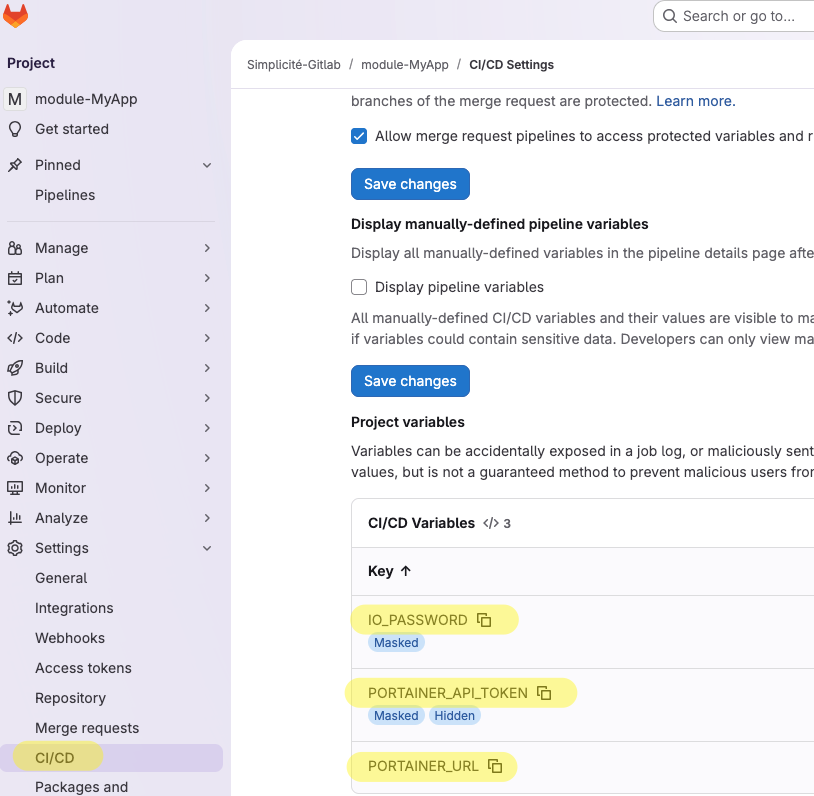
Finally, commit, push to gitlab (and you dev instance which is now behind), and check that the pipeline runs and deploys the test instance properly.
2- Unit tests
Simplicité
- add a unit tests shared code that tests a java shared code in the module
- commit & pull changes locally
Gitlab
The simci simplicite-run-unit-tests command calls the /io service
(with the IO password conveniently set up through the compose template at the deploy stage)
to instruct Simplicité to execute the unit tests of this module.
stages:
  - build
  - test # Add the "test" stage

[...]

unit-tests: # Add the "unit-test" stage
  stage: test
  script:
    - export PORTAINER_API_TOKEN="${PORTAINER_API_TOKEN}"
    - export IO_PASSWORD="${IO_PASSWORD}"
    - ./others/simci simplicite-run-unit-tests MyApp gitlab-test-myapp $PORTAINER_URL
Commit & push to gitlab (and the dev instance...), verify that unit tests execute properly.
Remember, if debugging of simci is ever needed, use local executiong with test-simci.sh
instead of gitlab runners for quicker testing.
3- Sonar & Code quality
Sonar
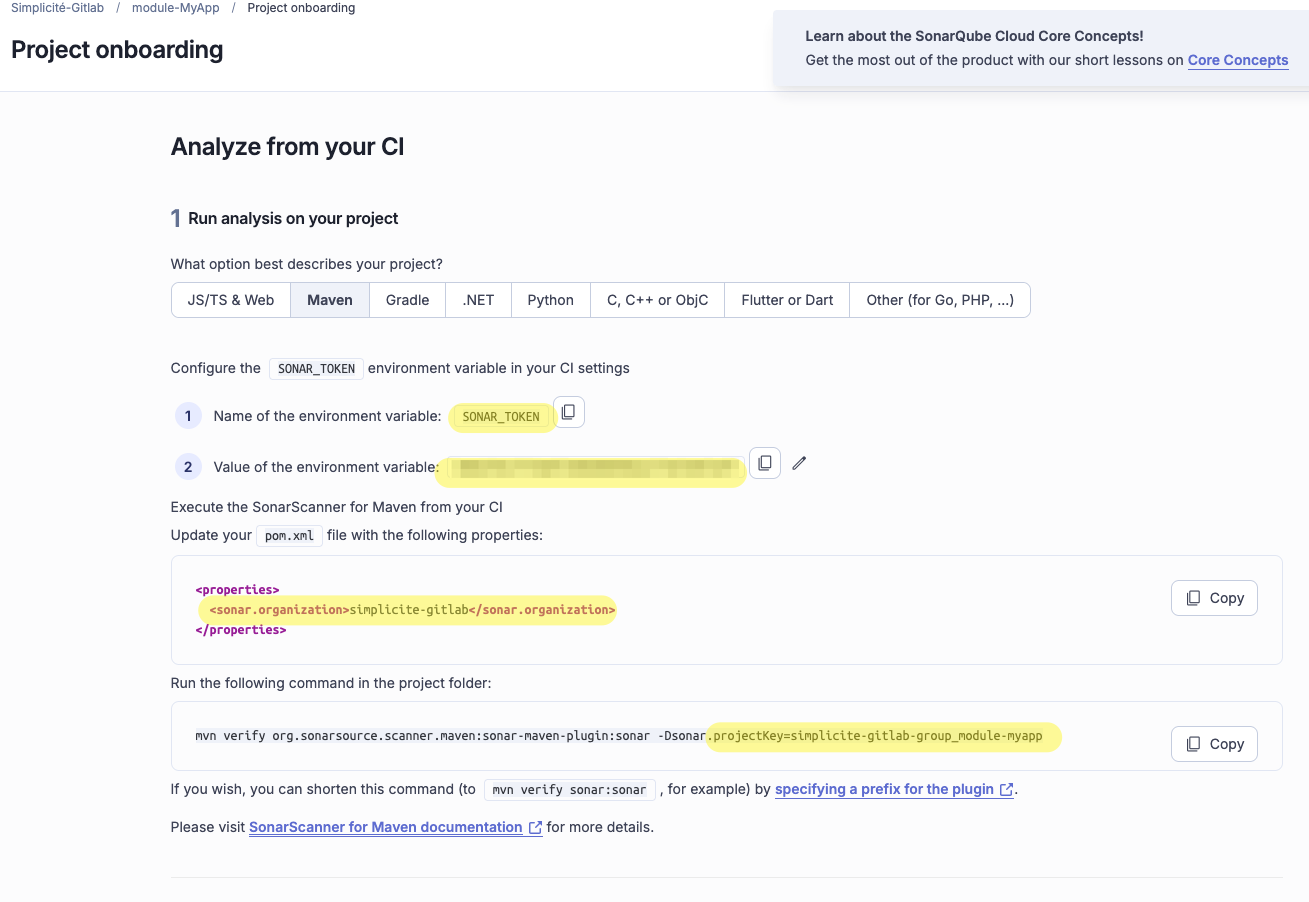
Connect to Sonar, it should detect your project. Select "With other CI Tools", then "Maven" and get the following values:
SONAR_TOKEN- organization
- projectKey
Simplicité
Configure Maven in the module settings:
{
	"type": "git",
	"origin": {
		"uri": "https://gitlab.com/simplicite-gitlab-group/module-myapp"
	},
  "export": {
    "format": "xml|json",
    "exploded": true|false
  },
	"maven": {
		"eslint": true,
		"stylelint": true,
		"jshint": true,
		"checkstyle": true,
		"repositoryUrl": "https://platform.simplicite.io/6.3/maven"
	},
	"sonar": {
		"projectKey": "<replace with sonar proj",
		"organization": "<replace with sonar organization name>",
		"host.url": "https://sonarcloud.io"
	}
}
Commit the change.
Pull locally and run mvn validate to check the code.
Gitlab
Sonar token
Set the SONAR_TOKEN variable in the Gitlab UI
Pipeline
Pull the maven changes from the dev instance, then update .gitlab-ci.yml to add:
- a
SONARCLOUD_ENABLEDvariable (analysis can take some time, it's usefull to be able to skip it) - a code-quality stage with a sonacloud-check job:
variables:
  SONARCLOUD_ENABLED: "true"

stages:
  - build
  - test
  - code-quality

[...]

sonarcloud-check:
  image: maven:3.9-eclipse-temurin-21-alpine
  stage: code-quality
  dependencies:
    - unit-tests
  cache:
    key:
      files:
        - pom.xml
      prefix: "${CI_JOB_NAME}"
    paths:
      - .sonar/cache
      - .m2/repository
  variables:
    MAVEN_OPTS: "-Dmaven.repo.local=.m2/repository"
  script:
    - apk update && apk add nodejs npm
    - ls -halt
    - mvn verify org.sonarsource.scanner.maven:sonar-maven-plugin:sonar
  rules:
    - if: '$SONARCLOUD_ENABLED'
Sometimes, on first analysis, Sonarcloud can set the "main branch" a something different than you actual main branch (usually master).
It's problematic on the free tier where Sonarcloud will only analyze that branch.
If that happens, delete the project on Sonarcloud, recreate it, update the token, and run another analysis.
4- Jacoco code coverage
Simplicité
Update module settings, and add the following line to the sonar section:
"coverage.exclusions": "resources/**.js"
Commit (and pull changes locally)
Docker configuration
Add the following data to the docker compose file, to generate a jacoco XML file during app usage (aka unit tests):
JACOCO_MODULESenvironment variable- a
jacoco-datavolume mounted at the specified path
services:
  simplicite:
	[...]
    environment:
      [...]
      JACOCO_MODULES: "MyApp"
	  [...]
    volumes:
      - jacoco-data:/usr/local/tomcat/webapps/ROOT/WEB-INF/dbdoc/content/jacoco
volumes:
  jacoco-data:
networks:
  proxy:
    name: proxy
    external: true
Pipeline configuration
- call
portainer-stack-get-coverageat the end of unit test execution job - instruct Gitlab to keep the jacoco file after unit tests have run
- attach that file to the sonar run with
-Dsonar.coverage.jacoco.xmlReportPaths=jacoco.xml
unit-tests:
  [...]
    - ./others/simci portainer-stack-get-coverage -v gitlab-test-myapp $PORTAINER_URL
  artifacts:
    paths:
      - jacoco.xml
    expire_in: 1 hour

sonarcloud-check:
  script:
    [...]
    - mvn verify [...] -Dsonar.coverage.jacoco.xmlReportPaths=jacoco.xml
  rules:
Final configuration
Do not attempt to just copy this final configuration files in an existing module. This is given as a reference, but the CI/CD functionnalities should be implemented step by step as described here. Each step requires coordination between the various components (instance, git, gitlab, sonar, etc), and doing everything at the same time will probably result in painful debug analysis.
Module structure
tree -a -I \.git
.
├── .checkstyle-configuration
├── .eslint-configuration
├── .gitattributes
├── .gitignore
├── .gitlab-ci.yml
├── .jshint-configuration
├── .stylelint-configuration
├── BUILD.md
├── configuration
│   ├── MyApp.json
│   └── Script
│       ├── MyappTests.json
│       └── MyAppTool.json
├── module-info.json
├── MyApp-openapi-3.0.2.yml
├── MyApp-swagger-2.0.yml
├── MyApp.md
├── others
│   ├── .env
│   ├── myapp-compose.yml
│   ├── simci
│   └── test-simci.sh
├── package-lock.json
├── package.json
├── pom.xml
├── README.md
├── resources
│   └── .gitkeep
├── src
│   └── com
│       └── simplicite
│           └── commons
│               └── MyApp
│                   └── MyAppTool.java
└── test
    └── src
        └── com
            └── simplicite
                └── tests
                    └── MyApp
                        └── MyappTests.java

15 directories, 26 files
Module settings
{
	"type": "git",
	"origin": {
		"uri": "https://gitlab.com/simplicite-gitlab-group/module-myapp"
	},
  "export": {
    "format": "xml|json",
    "exploded": true|false
  },
	"maven": {
		"eslint": true,
		"stylelint": true,
		"jshint": true,
		"checkstyle": true,
		"repositoryUrl": "https://platform.simplicite.io/6.3/maven"
	},
	"sonar": {
		"projectKey": "simplicite-gitlab-group_module-myapp",
		"organization": "simplicite-gitlab",
		"host.url": "https://sonarcloud.io",
		"coverage.exclusions": "resources/**.js"
	}
}
Docker compose file
services:
  simplicite:
    image: registry.simplicite.io/platform:6.3
    restart: unless-stopped
    container_name: ${COMPOSE_PROJECT_NAME}-app
    environment:
      IO_PASSWORD: "${IO_PASSWORD}" # Ignored unless 32 chars. Define through environment variable.
      DEV_MODE: true
      SIMPLICITE_SYSPARAM_USE_IO: "yes"
      SIMPLICITE_SYSPARAM_USE_IO_TESTER: "yes"
      MODULES_IMPORT_SPEC: |
        title: "${COMPOSE_PROJECT_NAME}"
        modules:
          - name: "MyApp"
            git:
              uri: "https://gitlab.com/simplicite-gitlab-group/module-myapp"
      JACOCO_MODULES: "MyApp"
    volumes:
      - jacoco-data:/usr/local/tomcat/webapps/ROOT/WEB-INF/dbdoc/content/jacoco
    networks:
      - proxy
    labels:
      - "traefik.enable=true"
      - "traefik.http.routers.${COMPOSE_PROJECT_NAME}-app.entrypoints=websecure"
      - "traefik.http.routers.${COMPOSE_PROJECT_NAME}-app.tls.certresolver=leresolver"
      - "traefik.http.services.${COMPOSE_PROJECT_NAME}-app.loadbalancer.server.port=8443"
      - "simplicite.subdomain=${COMPOSE_PROJECT_NAME}"
volumes:
  jacoco-data:
networks:
  proxy:
    name: proxy
    external: true
Gitlab pipeline config
variables:
  SONARCLOUD_ENABLED: "true"

stages:
  - build
  - test
  - code-quality

deploy-test:
  stage: build
  script:
    - export PORTAINER_API_TOKEN="${PORTAINER_API_TOKEN}"
    - export IO_PASSWORD="${IO_PASSWORD}"
    - ./others/simci portainer-stack-delete gitlab-test-myapp $PORTAINER_URL
    - ./others/simci portainer-stack-deploy -f ./others/myapp-compose.yml gitlab-test-myapp $PORTAINER_URL

unit-tests:
  stage: test
  script:
    - export PORTAINER_API_TOKEN="${PORTAINER_API_TOKEN}"
    - export IO_PASSWORD="${IO_PASSWORD}"
    - ./others/simci simplicite-run-unit-tests MyApp gitlab-test-myapp $PORTAINER_URL
  artifacts:
    paths:
      - jacoco.xml
    expire_in: 1 hour

sonarcloud-check:
  image: maven:3.9-eclipse-temurin-21-alpine
  stage: code-quality
  dependencies:
    - unit-tests
  cache:
    key:
      files:
        - pom.xml
      prefix: "${CI_JOB_NAME}"
    paths:
      - .sonar/cache
      - .m2/repository
  variables:
    MAVEN_OPTS: "-Dmaven.repo.local=.m2/repository"
  script:
    - apk update && apk add nodejs npm
    - ls -halt
    - mvn verify org.sonarsource.scanner.maven:sonar-maven-plugin:sonar -Dsonar.projectKey=simplicite-gitlab-group_module-myapp -Dsonar.coverage.jacoco.xmlReportPaths=jacoco.xml
  rules:
    - if: '$SONARCLOUD_ENABLED'